< Intro to an Analytical Study of What Early Christians Taught
July 3, 2026 (about 60 slides)
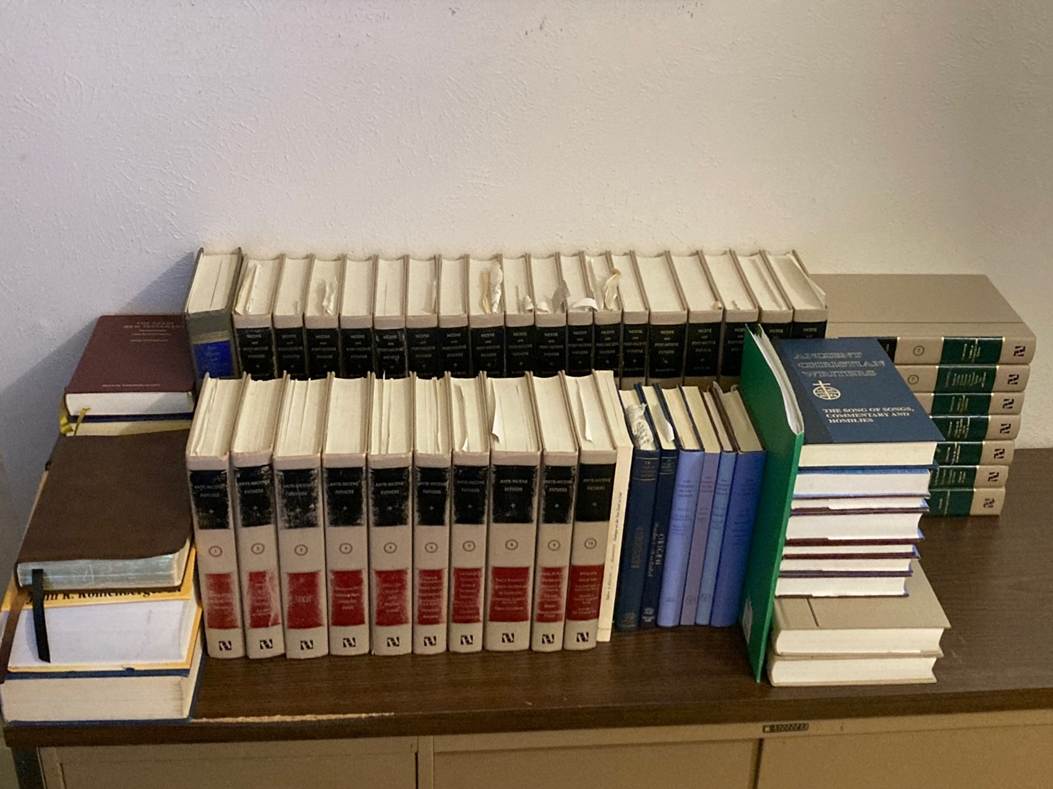
First of all, let’s have a look at what we are talking about when we speak of early Christian writings. The vertical books on the far left are Bibles. The books vertical on the front row are the Christian writings prior to the Council of Nicea in 325 A.D. The other horizontal books are after Nicea.
I have heard various people challenge these true statements.
"The early church believed in the Trinity."
"The early church believed in the authority of God’s Word."
"The early church knew nothing about venerating Mary."
“Icons were not a part of the gospel for early Christians.”
When someone claims the early church taught something, a fair question to ask is: “How do you know?” Even though we have about 5,480 pages by 92 or so writers, how do you determine what they consistently taught vs. what is an outlier?
Eight parts to know what the “early Church” taught
1. Why this matters to us today
2. When was the early church?
3. Who are the Christian writers vs. heretical ones?
4. Which writings do we have?
5. How do we determine what was taught?
6. Where do we set the cutoff on a consensus?
7. How should we define the following time period?
8. How does this compare with the following time period?
1. Three reasons why this matters to us today
The Envelope of possible truth
- vs. weird and innovative Bible interpretations
The Envelope of heresy
- vs. just an error
The Envelope of importance
Primary, secondary, and less importances, - mountains vs. molehills
2. When was the early church?
Brief answer: Up to a major milestone: the Council of Nicea I 325 A.D.
Many changes after this time.
Christianity finally a “legal religion” starting in 313 A.D.
In the Roman Empire no more persecution of Christians by 325 A.D.
Persecution because worse in the Persian Empire though.
Athanasius of Alexandria and Eusebius of Caesarea, spanned Nicea. Only their pre-Nicene writings are included.
3. Who was the early church (vs. heretics)?
The strong affinity of the “proto-orthodox”. This includes the main “denomination” plus Quartodecimians, Montanists, Donatists, and we will include Novatianists.
After this time, no discontinuity between the proto-orthodox and the main orthodox, Nestorians, Monophysites (Copts), and Arians.
There are three ways to answer this question; they all give similar results though.
3a) Relationships among the churches accepting each other
3b) Historical acceptance of Christian writers by other Christian writers
3c) Similarity of their teachings vs. outside groups
3a. Early churches accepted each other
Irenaeus of Lyons (182-188 A.D.) explains this in detail. “True knowledge is [that which consists in] the doctrine of the apostles, and the ancient constitution of the Church throughout all the world, and the distinctive manifestation of the body of Christ according to the successions of the bishops, by which they have handed down that Church which exists in every place, and has come even unto us, being guarded and preserved without any forging of Scriptures, by a very complete system of doctrine, and neither receiving addition nor [suffering] curtailment [in the truths which she believes]; and [it consists in] reading [the word of God] without falsification, and a lawful and diligent exposition in harmony with the Scriptures, both without danger and without blasphemy; and [above all, it consists in] the pre-eminent gift of love, which is more precious than knowledge, more glorious than prophecy, and which excels all the other gifts [of God].” Irenaeus, Against Heresies book 4, ch.33.8 p.508
Irenaeus of Lyons (182-188 A.D.) But [it has, on the other hand, been shown], that the preaching of the Church is everywhere consistent, and continues in an even course, and receives testimony from the prophets, the apostles, and all the disciples-as I have proved-through [those in] the beginning, the middle, and the end, and through the entire dispensation of God, and that well-grounded system which tends to man’s salvation, namely, our faith; which, having been received from the Church, we do preserve, and which always, by the Spirit of God, renewing its youth, as if it were some precious deposit in an excellent vessel, causes the vessel itself containing it to renew its youth also.” Irenaeus Against Heresies book 3 ch.21.1 p.451
Tertullian (198-220 A.D.) “We hold communion with the apostolic churches because our doctrine is in no respect different from theirs. This is our witness of truth.” Prescription Against Heretics ch.21 p.252-253. So even though Tertullian was a Montanist, he saw no problem with unity with the proto-orthodox.
Alexander of Alexandria (313-326 A.D.) “Since the body of the Catholic Church is one, and it is commanded in Holy Scripture that we should keep the bond of unanimity and peace” Epistles on the Arian Heresy Letter 2 ch.1 p.296
3a Counterpoint
Montanists including Tertullian accepted the proto-orthodox, but many proto-orthodox did not accept them. Cyprian did though. Novatianists and proto-orthodox did not accept each other, but they had the same teachings except that Novatianists believed those who had once denied their faith could never get forgiveness from God.
3b) Examples of Historical acceptance of proto-orthodox Christian writers by other writers
|
Later Writer |
Referenced earlier writer |
|
Ignatius, disciple of John the Apostle |
Clement of Rome, Polycarp |
|
Martyrdom of Ignatius |
Ignatius |
|
Papias, disciple of John the Apostle |
|
|
Polycarp, disciple of Ignatius |
Ignatius |
|
The Encratite Gnostic Tatian |
Justin Martyr was his teacher |
|
Evarestus |
Wrote Martyrdom of Polycarp |
|
Serapion |
Claudius Apollinarius |
|
Dionysius of Corinth |
Clement of Rome |
|
Melito of Sardis |
Ignatius, Polycarp, Justin Martyr |
|
Hegesippus |
Hegesippus, Shepherd of Hermas, Justin Martyr |
|
Irenaeus of Lyons, disciple of Polycarp |
Clement of Rome, Papias, Polycarp, Evarestus, “Elders”, Hermas, Justin Martyr |
|
Caius and the Muratorian Canon |
Justin Martyr, Tatian, Clement, Irenaeus, Melito |
|
Clement of Alexandria |
Clement of Rome, Epistle of Barnabas, Hermas |
|
Tertullian |
Clement of Rome, Polycarp, Justin Martyr, Irenaeus, Perpetua and Felicitas |
|
Asterius Urbanus |
Quadratus |
|
Hippolytus of Portus. He was a disciple of Irenaeus according to Photius I (9th century) |
Apollinaris, Irenaeus. Accepted Quartodecimians (such as Meleto of Sardis and Anatolius) despite them celebrating Easter on a different day. |
|
Julius Africanus |
Exchanged letters with Origen |
|
Origen |
Clement of Rome, Ignatius of Antioch, Epistle of Barnabas, Shepherd [of Hermas], the “admirable” Justin Martyr, Irenaeus of Lyons, Julius Africanus. Some corrections of his “predecessor” [Clement of Alexandria]. |
|
Cyprian of Carthage |
Polycarp, Tertullian, Roman Church leaders, Lucius et al., Caldonius, Celerinus, Cornelius, Moyses et al., Maximus et all. Firmilian of Caesarea, Nemesianus et al., Lucius and the brethren, Felix and martyrs |
|
Celerinus |
Ignatius, Cyprian of Carthage |
|
Firmilian |
Cyprian of Carthage |
|
Seventh Council of Carthage |
Clement of Rome, Justin Martyr |
|
Pontius |
Wrote The Life and Passion of Cyprian |
|
Gregory Thaumaturgus (Origenist) |
Wrote The Oration and Panegyric Addressed to Origen. |
|
Dionysius of Alexandria (A student of Origen) |
Wrote to Dionysius of Rome, Stephen of Rome, Sixtus II of Rome, Cyprian of Carthage |
|
Anatolius |
Irenaeus, Clement of Alexandria, Hippolytus, Origen |
|
Pamphilus of Alexandria (Origenist), disciple of Pierius (Origenist) |
Wrote an Apology [Defense] of Origen |
|
Methodius |
Justin Martyr |
|
Lactantius, disciple of Arnobius |
Minucius Felix, Theophilus of Antioch, Tertullian, Cyprian of Carthage |
|
Eusebius of Caesarea, (Origenist), church historian and disciple of Pamphilus |
Clement of Rome, Papias, Ignatius, Aristides, Quadratus, Barnabas, Polycarp, Hermas, Justin Martyr, Rhodon, Claudius Apollinaris, Dionysius of Corinth, Tatian (at first OK then later a heretic), Athenagoras, Melito of Sardis, Hegesippus, Martyrs of Vienna and Lugdunum, Theophilus of Caesarea, Theophilus of Antioch, Irenaeus, Maximus of Jerusalem, Polycrates, Caius, Serapion of Antioch, Apollonius of Ephesus, Clement of Alexandria, Tertullian, Asterius Urbanus, Hippolytus, Julius Africanus, Origen, Cyprian of Carthage, Gregory Thaumaturgus, Dionysius of Alexandria, Dionysius of Rome, Anatolius, Theonas, Phileas of Thmuis, Hesychius of Egypt, Alexander of Alexandria |
|
Origenists such as Theognostus, Alexander of Alexandria |
Origen. |
|
After Nicea I (325 A.D.) |
|
|
Formicus Maternus |
Epistle of Barnabas |
|
Athanasius of Alexandria, mentored by Alexander of Alexandria |
Ignatius, Shepherd [of Hermas], Theognostus, Dionysius of Alexandria, Dionysius of Rome, Origen, Eusebius of Caesarea (first an Arian “accomplice”, then a signer of Nicea), Marcellus |
|
Cheltenham Canon |
Cyprian of Carthage |
|
Apostolic Constitutions |
Ignatius of Antioch |
|
Didymus the Blind |
Origenist. Epistle of Barnabas, Shepherd of Hermas |
|
Ambrose of Milan |
said Origen’s expositions of the NT are inferior to Origen’s expositions of the OT. Basil, Didymus, Athanasius |
|
Jerome of Stridon |
Hippolytus, Tertullian, Eusebius of Caesarea (Letters of Augustine Letter 75.6.12 p.341), Cyprian of Carthage. Saw errors in Origen. |
|
Augustine of Hippo |
Says about Origen to accept what is true but reject what is false. Letter 40 (to Jerome) ch.5.4 p.274. |
3b Counterpoint: All was not rosy though, as the table below shows. Also, Origen was considered a heretic three centuries later. Origen unfortunately had over-allegorical interpretation, believed in pre-existence of souls, and eventual universal salvation. Jerome early on thought Origin was the greatest teacher after the apostles, but later in life Jerome reversed his view.
|
Christian Writer |
Writer or group they criticized |
|
Tertullian |
Against The Shepherd [of Hermas] |
|
Serapion of Antioch |
Against Montanists |
|
Apollonius of Ephesus |
Against Montanists |
|
Asterius Urbanus |
Against Montanists |
|
Treatise Against Novatian & On Rebaptism |
Against Novatian |
|
Cyprian of Carthage, Council of Carthage |
Against Novatian & Montanists |
|
Dionysius of Alexandria |
Against Novatian |
|
Methodius |
Criticized Origen’s teaching |
|
Council of Arles I (26-44 bishops) |
Excommunicated Donatists |
|
Eusebius of Caesarea |
Against Novatian & Montanists |
|
After Nicea I (325 A.D.) |
|
|
Athanasius of Alexandria |
Against Novatian |
|
Pacian of Barcelona |
Against Novatian |
|
Jerome of Stridon |
Wrote of errors of Novatian and Cataphrygians (= Montanists) |
|
Augustine of Hippo |
Against Novatian |
3c) Teaching Similarities vs. outside groups
3c1) What the proto-orthodox themselves said about rejecting outside groups
3c2) Contrasting outside groups at a high level
3c3) Comparing proto-orthodox teaching vs. outside groups
- have to compare in a consistent “apples-to-apples” way though
3c1) Counts of what the proto-orthodox themselves said
Are Boston Red Sox fans and New York Yankees fans basically rooting for the same team?
Or2. No mixing Christ and other religions (14)
Or8. Dispute with Ebionites/ Hebion [from Cerinthus] (7)
Gn1. The creator of good (Gnostics all said he was either misguided or evil) (20)
Gn2. Do not call matter evil (5)
Gn3. Avoid docetic beliefs – that Jesus did not suffer in the flesh (12)
Gn4. Against Cerinthus (6)
Gn9. Against Marcion (19)
Gn10. Against Valentinian Gnostics (15)
3c1) Counts of what the proto-orthodox themselves said - continued
Gn11. Specifically against the Valentinian Gnostic offshoot of Heracleon (5)
Gn12. Against Sethian/Ophite Gnostics (5)
Gn13. Against the Gnostic Apelles (6)
Gn14. Against the Gnostic Basilides (8)
Gn15. Against Encratite Gnostics (5)
Gn16. Against the Encratite Saturninus/Saturnilus (4)
Gn17. Against other Gnostics (14)
Gn18. The [Gnostic] Demiurge is false (6)
Gn19. The [Gnostic] Ogdoad is false (4)
Gn20. The [Gnostic] Pleroma is false (5)
3c Counterpoint: Eight writers were against Novatianists, and five writers were against Montanists. Tertullian was a Montanist later in life.
3c2) Contrasting the outside groups at a high level
Gnostics had a different God
Gnostics had a different Jesus
Gnostics had a different salvation
Gnostics had a different way of living
- - - - - - - - - - - - - - - - - - - - -
Ebionites (non-Gnostics)
3c3) A detailed comparison of proto-orthodox teachings vs. outside groups
1,238 teachings that four or more writers affirmed and none denied.
Will analyze 1,112 teachings.
Will analyzed at the level of four or more writers affirmed, and eight or more confirmed.
Unreasonable to compare a large number of pages (5480.4) with much smaller numbers: 273 & 282.
So we have to make roughly “slices” of 280-page of early Christian writings for comparison purposes.
|
Grouping of writers on topics with four or more writers agreed and none denied |
Pages |
Date range |
Topics cited |
% of total |
% divided by average |
Topics denied |
|
|
92 Christian writer totals |
5480.4 |
96-325 AD |
1112 |
100% |
- |
0 |
|
|
7 Ebionite heretic totals |
273.25 |
c.188-325 |
349 |
31% |
0.55 |
-15 (1%) |
|
|
Gnostics, Encratites, Bardesan |
282 |
c.150-325 |
315.5 |
28% |
0.50 |
-77 (7%) |
|
|
9
D A T A
S L I C E S |
Clement of Rome to Dionysius of Corinth, Vienna |
263 |
96-180 AD |
722 |
65% |
1.14 |
|
|
Irenaeus Against Heresies to Scillitan Martyrs |
268.25 |
182-217 AD |
701 |
63% |
1.11 |
|
|
|
Proof of Apostolic Preaching, Stromata |
268.5 |
160-202 |
577 |
52% |
0.91 |
|
|
|
Athenagoras to Theophilus, Caius to Apollonius, rest of Clement of Alexandria, Asterius Urbanus |
263 |
177-232 AD |
625 |
56% |
0.99 |
|
|
|
Tertullian’s 5 Books, Monogamy, Modesty; Theodotus to Alexander of Cappadocia |
270.25 |
240-251 AD |
580 |
52% |
0.92 |
|
|
|
Hippolytus, Novatian and foes |
274 |
222-254 |
675 |
61% |
1.07 |
|
|
|
Cyprian of Carthage and friends |
271.75 |
c.246-258 |
690 |
62% |
1.09 |
|
|
|
Origen’s On Prayer and Exhortation to Martyrdom, Pontius to Anatolius |
268.5 |
233-280 AD |
404 |
36% |
0.64 |
|
|
|
Adamantius, Victorinus, Pamphilus to Athanasius, Lactantius’ Epitome, 2 Alexanders |
274.3 |
300-326 AD |
705 |
63% |
1.12 |
|
|
|
…average |
269.1 |
|
631.0 |
57% |
|
|
|
|
Grouping of writers on topics with eight or more writers agreed and none denied |
Pages |
Date range |
Topics cited |
% of total |
% divided by average |
Topics denied |
|
|
92 Christian writer totals |
5480.4 |
96-325 AD |
570 |
100% |
- |
0 |
|
|
7 Ebionite heretic totals |
273.25 |
c.188-325 |
269 |
47% |
0.64 |
-14 (2%) |
|
|
Gnostics, Encratites, Bardesan |
282 |
c.150-325 |
235.5 |
41% |
0.56 |
-52 (9%) |
|
|
9
D A T A
S L I C E S |
Clement of Rome to Dionysius of Corinth, Vienna |
263 |
96-180 AD |
474 |
83% |
1.12 |
|
|
Irenaeus Against Heresies to Scillitan Martyrs |
268.25 |
182-217 AD |
446 |
78% |
1.06 |
|
|
|
Proof of Apostolic Preaching, Stromata |
268.5 |
160-202 |
383 |
67% |
0.91 |
|
|
|
Athenagoras to Theophilus, Caius to Apollonius, rest of Clement of Alexandria, Asterius Urbanus |
263 |
177-232 AD |
432 |
76% |
1.02 |
|
|
|
Tertullian’s 5 Books, Monogamy, Modesty; Theodotus to Alexander of Cappadocia |
270.25 |
240-251 AD |
392 |
69% |
0.93 |
|
|
|
Hippolytus, Novatian and foes |
274 |
222-254 |
428 |
75% |
1.02 |
|
|
|
Cyprian of Carthage and friends |
271.75 |
c.246-258 |
453 |
79% |
1.07 |
|
|
|
Origen’s On Prayer and Exhortation to Martyrdom, Pontius to Anatolius |
268.5 |
233-280 AD |
299 |
52% |
0.71 |
|
|
|
Adamantius, Victorinus, Pamphilus to Athanasius, Lactantius’ Epitome, 2 Alexanders |
274.3 |
300-326 AD |
491 |
86% |
1.16 |
|
|
|
…average |
269.1 |
|
422.1 |
74% |
|
|
|
Interpretation
Similar percentages for 4-or-more and 8-or-more teachings.
Ebionites and Gnostics have significantly lower similarity.
4. The Preserved writings we have
24 until Irenaeus (188 A.D.)
22 more until the persecution of Decius (251 A.D.)
46 more until 325 A.D.
92 writers, who together have a total of 5480.4 pages preserved
A page is defined here as a typical ANF page, around 848 words
This excludes 14 known corrupt or spurious works.
|
proto-orthodox writer |
pages |
% total |
proto-orthodox writer |
pages |
% total |
|
…total |
5480.4 |
100 % |
…total |
5480.4 |
100 % |
|
Eusebius of Caesarea |
1,055.4 |
19 % |
Theophilus of Antioch |
32 |
1 % |
|
Origen |
1,005 |
18 % |
Gregory Thaumaturgus |
28.5 |
1 % |
|
Tertullian |
928 |
17 % |
Minucius Felix |
25 |
0 % |
|
Clement of Alexandria |
389.5 |
7 % |
Victorinus of Petau |
18.5 |
|
|
Lactantius |
305.5 |
6 % |
Clement of Rome |
16.25 |
|
|
Irenaeus |
284.75 |
5 % |
Commodianus |
16 |
|
|
Cyprian of Carthage |
250.5 |
5 % |
Ignatius of Antioch |
13 |
|
|
Hippolytus |
218 |
4 % |
Epistle of Barnabas |
12.5 |
|
|
…remainder |
1043.6 |
19 % |
Alexander of Lycopolis |
12 |
|
|
Arnobius |
126.5 |
2 % |
Alexander of Alexandria |
11.5 |
|
|
Justin Martyr |
116.5 |
2 % |
Melito of Sardis |
11 |
|
|
Tatian’s Diatessaron |
86 |
2 % |
Treatise on Rebaptism |
11 |
|
|
Methodius |
79.5 |
1 % |
Julius Africanus |
9 |
|
|
Athanasius before Nicea |
56 |
1 % |
Peter of Alexandria |
8.5 |
|
|
Shepherd of Hermas |
46.5 |
1 % |
14 writers |
6 < 8 |
|
|
Adamantius |
42 |
1 % |
7 writers |
3 to < 5 |
|
|
Dionysius of Alexandria |
39.5 |
1 % |
17 writers |
1 to < 3 |
|
|
Novatian |
38.5 |
1 % |
21 writers |
< 1 |
|
5. What was explicitly taught, implied, or only partially mentioned
1,238 common teachings have been found, and I have labeled them as Gtxx, Fmxx, Jpxx, etc.
An explicit reference to a teaching
An implied reference to a teaching
A partial reference to a teaching
How to differentiate
A reference is explicit if they teach the doctrine, experience, or practice or else write that not believing the teaching is wrong. It is implied if they did not say the teaching directly, but they would not have made that statement unless they believed that teaching. It is partial if they only address part of that teaching, or mention it without affirming that it is true. In adding up what was taught, explicit and implied count 100%, and partial is not counted at all.
How well does this work? Here is a test for you to figure out for yourself.
Sa4. Saved by Jesus’ blood or dying for us. Alexander of Alexandria (313-326 A.D.) says that Christ was the cause of our redemption, blood for blood. Epistles on the Arian Heresy Epistle 5 ch.6 p.302
Gt5: God does not speak lies / is Truth: Clement of Rome (96/98 A.D.) “Look carefully into the Scriptures, which are the true utterances of the Holy Spirit. Observe that nothing of an unjust or counterfeit character is written in them.” 1 Clement ch.45 p.17. FYI, a total of 15 pre-Nicene writers affirm teaching Gt5.
Jp18. Jesus rose from the dead: Clement of Rome (96/98 A.D.) “Let us consider, beloved, how the Lord continually proves to us that there shall be a future resurrection, of which He has rendered the Lord Jesus Christ the first-fruits by raising Him from the dead.” 1 Clement ch.24 vol.1 p.11; vol.9 p.236. See also 1 Clement ch.42 vol.9 p.241. FYI, a total of 34 pre-Nicene Christian writers affirmed the teaching labeled Jp18.
Gt7. The Trinity: Clement of Alexandria (193-202 A.D.) “So that when he says, ‘Around the king of all, all things are, and because of Him are all things; and he [or that] is the cause of all good things; and around the second are the things second in order; and around the third, the third,’ I understand nothing else than the Holy Trinity to be meant; for the third is the Holy Spirit, and the Son is the second, by whom all things were made according to the will of the Father.” Stromata book 5 ch.14 p.468. FYI, a total of 19 Pre-Nicene Christian writers affirmed teaching Gt7.
Gt7. The Trinity: Justin Martyr (c.150 A.D.) says that we worship and adore the Father, Son, and the prophetic Spirit. He did not use the word Trinity though. First Apology of Justin ch.6 p.164
Fm4. No homosexuality: The Apology of Aristides (125 or 138-161 A.D.) p.275 mentions unrighteous things the gods did, such as slaying one another, practicing sorceries, adultery, thefts, and intercourse with males. FYI, a total of 14 Pre-Nicene Christian writers affirmed teaching Fm4.
n1. We need to repent and come to God: Hippolytus of Portus (222-235/236 A.D.) quotes Revelation 11:3 and said that Elijah was to come before the manifestation of Christ from heaven. There will be signs and wonders so that people will be put to shame and turn in repentance. Treatise on Christ and Antichrist ch.46 p.213. FYI, a total of 33 Pre-Nicene Christian writers affirmed teaching n1.
n12. Live a worthy life: Peter of Alexandria (306,285-311 A.D.) “And if it bear fruit, well; and if not, then after that thou shall cut it down.” Keeping this before their eyes, and showing forth fruit worthy of repentance, after so long an interval of time, they will be profiled.” [i.e., examined] Canonical Letter canon 3 p.270. FYI, a total of 25 Pre-Nicene Christian writers affirmed teaching n12.
n23. We are aliens awaiting our eternal home: Shepherd of Hermas (c.115-155 A.D.) book 3 Similitude 1 p.31 says that we live in a strange land, for our city is far away. A total of 7 Pre-Nicene Christian writers affirmed teaching n23.
Summaries: I have so far found 1,238 topics that four or more proto-orthodox Christians agree upon (explicit or implied), and none denied.
11,813 Explicit and Implied references by proto-orthodox writers, which makes an average of about 9.6 references by proto-orthodox per topic. Heretics have more than 105 explicit references. In all cases, when one writer makes a reference to the same topic multiple times, this is only counted once.
1,119 Implied references from both proto-orthodox and heretic writers.
949 Partial references from both proto-orthodox and heretic writers.
6. The cutoff for not saying this was generally accepted by early Christians
If four or more Christian leaders taught this and none denied it
Secondarily, we can also compare if at least one leader taught this from Nicea I to Ephesus I.
Now we will see a few examples.
Examples of teaching that had too few writers.
6a1) Cyprian of Carthage (252-258 A.D.) taught that baptized babies who died go to heaven, and unbaptized babies go to Hell. (Ambrose of Milan (370-390 A.D.) and Augustine of Hippo (383-430 A.D.) also taught this, but they are after the early church time period. No other Pre-Nicene writers are known to have taught or repeated this, so just one writer is not sufficient evidence that this was generally accepted.
6a2) Tertullian and Adamantius spoke of the “canon of scripture”. Clement of Alexandria had a “partial”, “the canon of truth explaining the scriptures”. So this is not counted as a teaching generally taught by early Christians since it only had two writers, not four.
6a3) A bishop can forgive sins was taught by Cyprian of Carthage (c.246-258 A.D.) but by no one else prior to 325 A.D.
A cutoff of 4 - 0
Given that we have 92 writers and 5,480.4 or so pages, a cutoff of four or more is reasonable. As the graph in the section 6 shows, a cutoff of 4 gives us 1,238 topics. If we had used 2, 3, 5, or 6 as cutoffs, that would give 1,536, 1,363, 1,051, and 885 topics respectively.
Examples of teaching that some denied
Here are a few of over 52 “divergences”
6b1) Pre-Nicene church writers quoted from apocryphal books, as well as Plato, Aristotle, and various other philosophers, etc. But Just quoting from a work does not prove that they thought it was scripture. Here are just places where they said an apocryphal book was “scripture” or “the Lord says”, or “the Holy Spirit says”. There are eight Pre-Nicene writers who called seven of the Apocryphal books Scripture or “the Lord says”. Tertullian quotes 1 Enoch (which is not in the Roman Catholic nor Easter Orthodox apocryphas) as scripture. However, Meleto of Sardis did not accept the apocryphal books are scripture. So proto-orthodox Christians did not have agreement on that.
6b2) The Father and Son are One “substance” as Colossians 2:9 implies. Ten early Christian writers taught this. However, two, Origen and Pierius of Alexandria, denied this, so there was no general consensus. Later, Orthodox, Nestorians, Copts, Roman Catholics, and Protestants all agree on this, but Arians denied this.
6b3) The rock of the church is Christ, with no mention of Peter. Six early Christian writers taught this: Justin Martyr, Shepherd of Hermas, Irenaeus of Lyons, Tertullian, Origen, and Victorinus of Petau. However, Cyprian of Carthage mentions “Peter, upon whom by the same Lord the Church had been built”, so there was no general consensus on this.
6c) Distribution of proto-orthodox teachings (up to 325 A.D.)


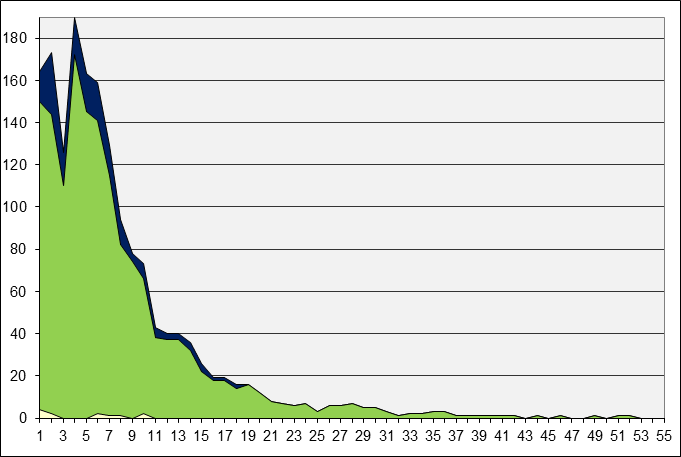
Count of writers who taught a teaching
7. What is the next time period?
Council of Nicea I (325 A.D.) to the Council of Ephesus I (431 A.D.). more than 13,000 pages.
a) Why not Nicea I to Chalcedon (451 A.D.)?
b) Why not include Nicea I to Ephesus I with the Pre-Nicene Period?
Different concerns, and corruption and decay began to set in
c) Why not split up the Pre-Nicene Period at 250-251 A.D.?
8. Comparing with the next time period (325-421 A.D.)
Pre-Nicene: about 92 Christian authors writing 5,480 pages.
300 A.D. Roughly 5 million Christians
Council of Nicea I to Council of Ephesus I (325-431 A.D.) about 130 Christians wrote more than 13,000 pages. Besides the top six writers, others wrote over 3,642 pages by others.
400 A.D. Roughly 10 million Christians
Comparison with Nicea to Ephesus writers (325-431 A.D.)
All 1,238 Pre-Nicene teachings taught by at least one writer except for these 6.
Gt13. [The Father is] the God of Jesus / Christ (7)
Rv12. Jesus rides the White Horse in Rev 19:11-16 (5)
Ut17. The wedding banquet in Rev 19:9 (5)
Po2. Don’t oppress the poor or afflicted (4)
Ap3. Answering false moral accusations against Christians (7)
Di12. Prophecy in the Church after Acts (8)
Nicea I to Ephesus I Christians also taught on many topics Pre-Nicene Christians did not.
Comparison with Churches today
Churches today would agree on all 1,238 teachings, except for 44 that various churches would not. 5 of these are agree by everybody today to be errors.
Er4. Four elements make up the world (7)
Er5. Atoms do not really exist (11)
Er8. Errors on the phoenix, hyena, or other animals (11)
Er9. Collective guilt of the Jews (7)
Er11. Number of nations according to angels (Dt 32:8 Septuagint) (8)
Of the 1,238 teachings only 109 are non-Biblical, though not anti-Biblical. An example of a non-Biblical teaching is that Pythagoras was wrong on some teaching.
8. Conclusions
We need to be objective.
Show me your witnesses!
Proposed standard: 4 or more Pre-Nicene proto-orthodox writers affirmed and none denied.
We will briefly touch on the following:
8.1 How Early Christian teachings compare with…
8.2 How this applies in conversations with…
8.3 We need to be able to back things up
8.4 Grids to help visualize the consensus
8.5 Where do we do from here?
8.1 How Early Christian teachings compare with…
Roman Catholics
Protestants
Eastern Orthodox
Nestorians
Copts
8.2 How this applies in conversations with…
Muslims
Mormons
Seventh-Day Adventists
Jehovah’s Witnesses
“Christian liberals”
Roman Catholics (and what I learned myself)
Greek Orthodox
8.3 We need to be able to back things up
So when someone says, “early Christian fathers like Augustine, Jerome, etc. said…” remind them that they are not early Christians. They were not pre-Nicene.
Whenever someone says, “early Christians believed…”, ask them to back it up. But when they ask you the same thing (which is only fair), you can go to www.biblequery.org/History/ChurchHistory/WhatEarlyChristiansTaughtOnDoctrine.html (or .docx) and
www.biblequery.org/History/ChurchHistory/WhatEarlyChristiansTaughtOnExperienceAndPractice.html (or .docx).
For the next period it is unfinished, but you can see what I have at
www.biblequery.org/History/ChurchHistory/WhatNiceaToEphesusChristiansTaughtOnDoctrine.html (or .docx) and
www.biblequery.org/History/ChurchHistory/WhatNiceaToEphesusChristiansTaughtOnExperienceAndPractice.html (or .docx).
8.4 Grids to help visualize the consensus
If you look at www.BibleQuery.org in the menu under History you will also find 68 grids showing what Pre-Nicene Christians taught (both .docx and .html). There is a Pre-Nicene section and also after Nicea.
8.5 Where do we do from here?
This article, and all the previous references focus on the commonality of what Christians taught, then and now. But the following three articles focus on something that is also interesting: the differences between what early Christians taught and what various churches today teach. Each of this is in both .html and .docx format.
www.BibleQuery.org/History/ChurchHistory/DifferencesInWhatChristiansTeachOnTheLordsSupper.html
www.BibleQuery.org/History/ChurchHistory/DifferencesInWhatChristiansTeachOnTheApocrypha.html
www.BibleQuery.org/History/ChurchHistory/DifferencesInWhatChristiansTeachOnMary.html
www.BibleQuery.org/History/ChurchHistory/DifferencesInWhatChristiansTeachOnRulesAndRulers.html
www.BibleQuery.org/History/ChurchHistory/DifferencesInWhatChristiansTeachOnOtherTopics.html